Sunday, May 3, 2015

Marseille

When we were deciding whether or not to move to Paris last year, one of the biggest items on the pro-moving side was travelling.  We already knew that we'd like to travel as much as possible in the first few years of being married and being located in the middle of western Europe would make that at lot easier and cheaper.  It was because of all of this theoretical travel that we started this blog.

Finally, after living here for 7 months, we finally started travelling in April...or at least I did.

Since my coworkers won't be coming to our wedding (it's a long way to go...I wouldn't go if someone wasn't making me), we decided to have an impromptu European bachelor trip to Marseille.

I will apologize a bit in advance.  Since this was a trip that was less about being a tourist and more about...well...drinking, I didn't take my SLR.  Where applicable, please excuse the potato-quality pictures.

Travelling by train in Europe is, without doubt, the best mode of transportation known to man.  You show up 15 minutes before your train leaves, bring whatever you want with you (within reason of course), and get to enjoy watching the countryside fly by at 300 km/h.  For anywhere within 800 km or-so of Paris, I wouldn't travel any other way.

Delicious sea creatures
We arrived in the middle of the afternoon on Saturday April 11th to a beautiful day.  Temperatures in the mid-20s in April is still a novelty that I'm not really sure will ever wear off.  Being right on the sea means that the seafood is quite excellent.  So we started our day with some moules (mussels) beside the harbour.  It was easily some of the best seafood I've had in my life.  The beer wasn't too shabby either.


A small section of preserved Roman wall with
the Porte d'Aix in the background.
Marseille is quite an interesting place, historically.  Once you start to peel back the layers, you can see it has been an important place for as long as there has been history.  Cave paintings in the nearby Cosquer Cave date back to at least 20,000 BCE.  It was an important Greek outpost that was home to Pythagoras (yes, THAT Pythagoras) and later became an important Roman trading port.  It was a hotbed of dissent in the years leading up to the French Revolution.  The song sung by the revolutionary volunteers as they marched from Marseille to Paris, La Marseillaise, is the French national anthem.  On top of all of that, Marseille was also the site of several bombings and battles in World War II.


 Cathédrale La Major (exterior)
After that we spent the afternoon exploring north of Marseille's old port.  With some rather lucky stumbling around we happened upon Marseille's second-most famous church, Cathédrale La Major.  It's a fantastic mix of Roman and Byzantine design resulting in a rather breathtaking collection of masonry.


 Cathédrale La Major (interior)
 Cathédrale La Major (interior)


After seeing some of the local sights, we went in search of dinner and nightlife.  This involved a fantastic restaurant named Mario's (which surprisingly featured a few Nintendo-themed dishes in what looked like a normal little Italian place) and a solid Irish pub staffed by real Irishmen.

Notre-Dame de la Garde (exterior)
On Sunday morning we, appropriately, went to a church (for a visit at least).  Marseille is home to the stunning Notre-Dame de la Garde perched atop a 500 foot-tall spire of rock next to the old port.  Thankfully you can take the bus.


Notre-Dame de la Garde (interior)
The interior is much more Byzantine than the Cathedral in the main part of town and is quite impressive.


The basilica was also the site of some fairly furious fighting while the Allies were liberating Marseille.  The scars are still visible on the side of the building.


But easily one of the best parts of being up a Notre-Dame de la Garde is the view.  I'll just let it speak for itself.
The old port and harbour

Marseille
Marseille was a great place to start this European Odyssey (even if it was just me...).  Expect to see a lot more in the next few weeks...

Friday, March 27, 2015

Travel Advice I - Checked Luggage

As most people know, before moving to France I used to spend more time in an airport in an average month than most people do in two or three years.  So I thought I would share a few of the things I learned along the way in a series of posts.

Note that all advice is based on personal experience of one person.  I am just a weary traveler sharing a few things I've picked up along the way.

Luggage.  This is quite simply something that can make or break any trip.  I think I'll start with checked luggage as it's a bit easier to deal with.  Also, as a forewarning for the next post, me talking about carry-on luggage can get a bit...ranty.

So, checked luggage...it's easy right?  You just have to haul it to and from the airport and your airline will take care of the rest.  ...mostly.  Even by their own admission, the barcode scanners that read the luggage tag stuck to your bag are at best 92% accurate.  This may sound pretty good until you look at the numbers.  Looking at just the weekend of American Thanksgiving, an estimated 24.6 million people will travel by air in the 12 days surrounding the holiday.

If we assume that a modest 50% of these people (12.3 million) check a bag, this means that likely around 492,000 pieces of luggage will be mishandled.  That is just a single fortnight in one country.  When you combine this with the delays of waiting for luggage to appear at the end of your flight, it means I avoid checking a bag as often as possible.

Unfortunately, due to modern security regulations, this isn't always possible.  If you need to take something with you that would not be allowed in the cabin of the plane (such as anything that could be a weapon or any larger containers of liquids), checking a bag becomes a necessity.  In fact, I almost always end up checking a bag just due to liquid restrictions.

I don't want to go into the reason why airlines have decided to charge baggage fees, but the fact is that they exist.  In my former life, I traveled enough that I very rarely had to pay to check a bag.  For example, on Air Canada I used to be able to check up to 3 bags weighing 70 kg each for free.  But that's not true for most people (now including me).  Taking my previous example, if we assume that half of the people who check bags (5.8 million people) have to pay a bag fee (averaging $25/bag), the airlines stand to make $153 million in ten days on just bag fees.

So far I've just been throwing around numbers.  Its time for some real advice.

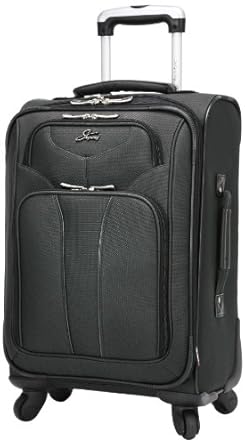
  1. When it comes to purchasing luggage, you need to strike a tricky balance.  More expensive luggage generally tends to last longer.  Some bags even come with a lifetime-no-questions-asked-yes-I-ran-over-my-luggage-with-my-car guarantee.  Pricier bags also tend to be lighter.  But you have to offset the cost vs how often you'll be flying.  In my experience, more expensive bags can take the beating baggage handlers give for much longer.
  2. Wheels are awesome.  The invention of the 2-wheeled roll-aboard was a huge improvement.  But when you have 30-50 pounds of crap you're dragging around, having a 4-wheel luggage on casters is a Godsend.  If you can, get a carry-on with 4 wheels.
  3. Hard case luggage will not guarantee protection from damage from aggressive baggage handlers. It's fairly simple physics: the energy caused by force acting on your bag has to "go" somewhere.  For cheaper hard case bags this likely means the zipper/clasps will break.  For more pricey bags it can mean your belongings are taking the brunt of that force.  I don't necessarily have anything against hard case luggage but just know that they're not going to magically prevent damage en-route.
  4. Pack Light.  If you don't need it, don't bring it.  If you're taking a longer trip, a small package of powdered soap weighs much less than more clothes.
  5. If you're trying to bring back anything fragile (souvenirs, alcohol, indigenous fauna, etc), dirty laundry makes a very good protective wrap.  I have brought back innumerable bottles of wine wrapped in laundry in my checked bag without ending up with a single wine-coloured t-shirt.  But, if it's something particularly valuable and/or precious to you, don't check it.  Carry it with you if you can or have it shipped home.
  6. On that note, DO NOT PACK VALUABLES IN CHECKED LUGGAGE.  In 10 seconds of searching I was able to find story after story after story of people having valuables (including everything from laptops to hundreds of thousands of dollars in jewelry) go missing from their checked luggage en-route.  Yet again, if it's something particularly valuable (especially electronics) and/or precious to you, don't check it.  Carry it, ship it, or just leave it at home.
  7. Once you're done packing, make sure to weigh your bag.  Use the bathroom scale if you have to.  It may not be accurate, but it will give you an idea of where you stand.  Get a $15 luggage scale if you want more accuracy.  You don't want to show up to the airport to find out you're overweight.  Never be this person:
  8. Check on the baggage allowance and maximum weight your airline allows.  This is usually around 50 lbs (22 kg), but it can vary.  Also note that this will generally vary depending on both how much you paid for your ticket as well as how far you're going.  As a general rule, the more you pay and the further you're going, the more free baggage you're allowed.  You can find some information on Netflights.com but I would recommend checking with your airline at least a few days before your departure.  Also be aware that airlines can and do change their policies.  Just because it worked last year does not mean it will work this year.
  9. If you are not flying direct to your destination, make sure to ask when you check in whether your luggage is checked through to your destination.  Depending on whether you have to clear customs and what country you're going to, you may need to collect your bag at some point in your trip.  For example, if you are flying from point A in Canada to point B in Canada and then connecting to point C in the US, you may have to collect your bags before clearing American customs at point B.  Your airline will usually tell you this at check-in.  If they don't just ask.
  10. Finally, the one thing most people don't consider is the part of your travel that won't be in the airport.  When deciding on the type/size/weight of your bag, consider how you will be getting to/from the airport.  For example, when Jessica and I moved to France we had 4 VERY large and VERY heavy suitcases.  But we were getting dropped off by family members with large vehicles in Edmonton and getting picked up by a taxi van in Paris.  If you're catching a bus or subway at your destination, keep in mind that hauling a big heavy suitcase through a crowded subway station after a multi-hour flight will make for a bad day.
I think that covers most of my lessons learned.  As a final piece of advice, remember that it's "just stuff".  If something goes wrong, you can almost certainly replace what you need and it'll make for a great story you'll be telling for years.

Happy Flying!

Wednesday, March 25, 2015

Customer Service

I worked in  customer service for nearly 11 years. Needless to say, during that time I learned the dos and don'ts of what to do as a employee, and what I SHOULD expect when shopping or going to a restaurant. At least I thought that was the case, then I moved to France.

I'm going to begin with restaurants.

In Canada my expectations at a restaurant are always the same at every restaurant from Boston Pizza or... Some fancy restaurant (can't you tell I went to lots of fancy restaurants). You get seated by an overly smiley host/ess, before your even sitting fully on your seat a waiter/ess is asking what you want to drink. Three minutes later they are back with your drink (maybe five if you ordered alcohol, which be honest, you did). Immediately after putting your drinks down they ask you for your order. If you are ready you give your order, if you are not ready they will come back every two minutes until you are. After placing your order you sit for ten to fifteen minutes until it is ready and then you eat. After you eat you settle your bill and you are out of there. This whole experience will have taken you 45 minutes. This experience also involved bottomless pop and you gave your waiter/ess a potentially generous tip.

Now, in France. You wait in a cramped "hallway" for five minutes, some waiter/ess notices you and gestures in a sit wherever fashion. You sit. You sit. You sit. FINALLY, the waiter/ess comes and plops down a menu and bustles off. You look at the menu. You look at the menu. You look at the menu. You flag down the waiter/ess and order your drink and food at the same time (if you are getting water be very careful to order tap water so you aren't paying for your water). The food comes fairly promptly. You eat your food. You sit. You sit. You sit. The waiter/ess comes back and asks if you want dessert. OF COURSE you want desert, you've been sitting long enough your food has settled, and hot damn, deserts are great here. You eat your desert. You sit. You sit. You sit. You settle your bill and leave. This whole experience has taken 2-4 hours. You did not get bottomless pop and you did not tip your waiter/ess. The reason you didn't tip isn't because you felt the service was subpar. it's because you just don't. Waiter/ess' make good money here so they aren't constantly at your table working (read: annoying you) to get a good tip.

I am really not sure which I prefer, I like aspects of each country. For Canada, I like the quick meal, and the bottomless pop. In France, I like the space you get and that you aren't getting asked "how is your meal?" when your mouth is full of food. Can we meet half way? Probably not.

Customer service in stores is fairly similar to how it is in Canada, perhaps a little more hands off. It is very rare to get more than a "bonjour" in a store. Perhaps this would be different in more specialty stores, but I haven't experienced that as of yet. It also seems that cashiers and floor staff might not be as "empowered" here as they are in Canada or they don't have the same level of responsibility. It is a very French thing that whatever shows up in the computer must be right. For example, I was at an IKEA buying towels, when my total came to something like 12,000€ I just looked at the cashier with a confused look (now I feel I could at least express my confusion, but that was then). She looked at the screen and pointed to the number with a shrug that said "it's in the computer" eventually, she called down a manager and the manager pointed out that she had inputted 4,000 towels, not four. Now, she might have just been new... Or kinda dumb.

I'm not going to say that this hands off style of customer service is necessarily better but, it is better for me. I prefer just to be left alone, especially since my French is still a little... Let's call it shaky.

Random story: A few years ago a lady got her cellphone bill for 17 billion euros. She called the cellphone company because OBVIOUSLY this is a mistake. They didn't look at it and immediately go "whoops, our bad!" they set her up with a payment plan. It took months before they realized someone had just made a decimal error. If wikipedia taught me anything it's that if it is on the computer it must be right.

photo credit: http://memeshappen.com/meme/ron-swanson/its-not-the-computer-its-you-2201


Bye for now!

Saturday, March 14, 2015

Casual Update

It's been a while since we have posted anything, needless to say it has been a few busy weeks. So here is a quick (and rather disorganized) update to what has been going on!

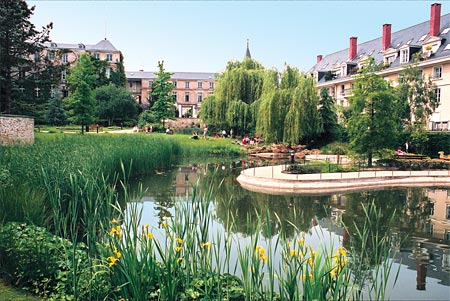
First of all, we had a visit from my friend Sara, so I spent two weeks showing her around Paris, and our little town of Le Plessis Robinson. We spent some time at the normal tourist places and explored some places a little more off the beaten path. I was surprised at some of the hidden gems that Plessis had to offer as well. I look forward to exploring more of my city this spring!

Photo credit: http://pedshed.net/blog/wp-content/uploads/2008/07/plessis-robinson-park.jpg


Speaking of Spring, we have learned that Spring is actually a full SEASON not just a couple weeks while the snow melts... Before it melts again and turns into winter 2.0 (or 10.0) as we had come accustomed to in Edmonton. Trees are budding, flowers are blooming (crocuses, daffodils, irises), and temperatures are rising, our daily highs are in the 12-17C range right now. Spring is also bringing some new birds to our area! Apparently, certain types of parakeets are wild around here. It started as pets escaping years and years ago and they just thrived ever since!

photo credit: http://www.kazeo.com/sites/fr/photos/849/les-perruches_849445-L.jpg

So the medical system... The French medical system is different than it is in Canada, we aren't at a point that I can say whether it is better or worse. It is necessary to have a general practitioner (GP), once you have your GP they will refer you to other doctors if needed and will take care of your primary care. We were lucky and found a GP who is from Canada, and speaks English natively. When you go into the doctor you pay the doctor the fee based on whatever your appointment entailed and then you have this reimbursed through social security and your health care insurance. Pharmacies are simply that, a place you go to get your prescriptions. I recently had to go to a dentist, now THAT is an experience along what seems to be a common thread amongst medical professionals. Gloves are not worn, it was a little bit of a shock to get my teeth looked at being able to taste the antiseptic on my dentists hand (I found some solace in that, at least I was tasting antiseptic, not his lunch). This has been a bit of a shock but it is how it is here.

We finally have some time to do some travelling, right now we have a trip booked to go to Denmark to visit some wonderful friends of ours. We are also going to London and Bristol as Jason got me a wonderful birthday gift of going to the Bristol zoo to see the new penguins (and the other wonderfully cute animals) and to watch Star Wars (specifically, "A New Hope") with DAVID PROWSE, for those that don't know, David Prowse is DARTH VADER. Our trip back to Canada for the wedding is booked, Lucy is coming with us, which will be... An adventure all on it's own.

That's all for now!


Saturday, February 21, 2015

10 Tips and Tricks For Learning a New Language

Bonjour!

Well it has been six months of trying to learn a new language and we have certainly learned a ton, not just about speaking French but also how to learn a new language here are some valuable tidbits that we have learned and are going to pass on to you!

  1. Review the basics of your native language first. 
    Do you remember what a noun is? Adverb? Adjective? What is a reflexive verb? When you are learning a new language you are going to be hearing all the "technical" words for each kind of verb, tense, etc. It's important to understand what they are in your own language first. It will make it easier to learn in the long run.
  2. Remember it won't be instant. 
    This isn't The Matrix we are talking about here, you can't just get plugged into a machine and have all the knowledge (how awesome would that be though?!). It takes time, it takes practice and most importantly, it takes lots and lots of patience.
  3. Reading, speaking and understanding the language are three very different things.
    For example, I can read French almost perfectly, I can speak it ok, but, I really struggle with understanding what people are saying. The worst is trying to understand over the phone. This may sound creepy, but I don't care, if you are in the country where people speak the language you are trying to learn listen in to people's conversations. Try to understand what they are saying. It sounds weird I know, but frankly, if they are speaking loud enough that you can hear what they are saying it hardly counts as "eaves dropping".
  4. The internet is magical.  Don't be ashamed to use it. 
    There are tons of resources online to learn how to speak a language, most are free. I am personally a fan of Duolingo (www.duolingo.com) it used a very natural style of language learning and encourages you to keep at it. If you don't know a word, use a translater. Just do it, don't be ashamed but after you look it up use whatever technique you use (repetition, writing, use it in a sentence etc) and hopefully you won't need to look it up again.
  5. Watch TV and movies with the language you are learning subtitles on and vice versa. 
    I think it is best to watch shows or movies you have already seen, that way you don't need to pay as much attention to the plot and just focus on the subtitles and somewhat on what is being said. By watching the other language shows with English subtitles on you can work on your oral comprehension as well.
  6. Most importantly, just speak
    You are going to sound like an idiot, embrace it. Your accent is going to be off (chances are it always will be), your prononciation is probably going to sound weird. The people you are going to be talking to are going to know you aren't a native speaker and that's ok. It will get better the more you use it.
  7. Avoid using your native language.
    In my experience a lot of people DO speak English outside of English speaking countries. I have found quite often that I will be talking to someone they will sense I don't speak French fluently and they will start speaking English. They really think they are doing you a favour, trust me, they are not. Whenever people do this to me (perhaps a waiter, clerk etc) I will just keep speaking French. They usually get the hint and humour me. Of course there are situations where English speaking is a bit more important, for example, at the doctor, you don't want any translate issues there.
  8. Learn some key phrases right off the bat.
    This seems obvious, but I am not just talking about asking where the bathroom is. Learn how to tell people you only speak a bit of <language> and ask them to speak slowly and simply. Knowing numbers is more important than you might think so learn to count to 100 or so it will make your retail encounters much easier. Learning the letter prononciations is important if you think you might be in a situation that you will be spelling out something, like your name. In French the letter I is pronounced how the letter E is pronounced in English. Learning some basics of food names will be good to have for restaurants. Luckily, if you are Canadian and trying to learn French you have a bit of an edge there. YAY for dual language packaging. If you have any allergies such as food or medical allergies learn how to express this!
  9. Put yourself in the shoes of the people you are speaking to.
    Have you ever spoken to someone who doesn't speak very good English? Probably. Did they say some things that sounded... odd or not quite right? Yes. Did you understand what they were saying? Woah. Yes! When you realized they didn't speak very good English did you use simpler phrasing and speak slower? Yes. Well there you go. Just speak. The human brain is an amazing thing, it fills in blanks and modifies your behaviour and mannerisms all on it's own.
  10. Body language is truly universal.
    Pointing, shrugging, smiling etc. These pretty much all mean the same thing in every country (there are a few exceptions of course). If you are at a restaurant and aren't comfortable saying what you want just point to it on the menu, they'll get it pretty quick that you don't speak <language>. 


That's all for now!

Monday, January 26, 2015

You saw it coming... A post about our new dog (and pet owning oddities)

I could definitely write a ten page post exclusively about Lucy, our new puppy. But I'm not going to do that. This post will be a mix of talking about Lucy (obviously) and just some of the weird things about pet ownership in France.

We got Lucy on January 8 at a French pet store called Animalis. Please keep all of your thoughts about pet stores being the devil to yourself. At first we were both also a little reluctant about getting a dog from a pet store but after hours and hours of research and going to the pet store multiple times to check out living conditions, animal conditions and how the staff treat the animals we decided that we could trust this pet store, and after having Lucy for almost three weeks my trust hasn't wavered. We did originally want to use a breeder but given our situation it was an impossibility. All of the breeders are WAY out in the country and without a car and with the obvious language barrier, there was no practical way for us to be able to make the multiple trips out to the breeder. We have all the information on the breeder that Lucy came from and it definitely was not a puppy mill.

Moving on.

A few days before we got Lucy we went and got all the supplies we needed for her and the day we got her we really weren't expecting to actually get her that day, we saw her and knew that she was coming home with us. So we flagged down an employee, I was super confident that I was going to be able to handle this all in French, I even had it planned in my mind EXACTLY what I was going to say, and then I panicked and said "Desole! Je ne parle pas Francais! Vous parlez Anglais, peut-etre?" The guy that we originally was going to be working with did not, but a co-worker of his did. He came over and the process got started. First, he gave us a few minutes to get acquainted with her as he grabbed some paperwork and then we got started as we knew she was going to be our puppy. After about an hour of going over everything from her previous vet visits, and when vaccinations were due (all was fine, and she was due for her last vaccine in a week, which she has now) we were on our way.


A very strange thing about pet ownership is the pricing of the animals. For reference the current exchange rate is 1€ = 1.40$CAD. A labrador will cost you about 750€, a smaller dog 800€-900€, a French Bulldog 1,200€ and a cat will run a shocking 1,300€-1,500€. Crazy, I do understand why in France a bigger dog would be a little less expensive, there just isn't as many of them (in the city at least, I will address this a little more later) so the demand for smaller dogs is higher. But a CAT for 1,500€ WHAT?!

In the city, there aren't a lot of bigger dogs, but out in the suburbs there are TONS. Housing is much larger, it is much easier to take a dog for a long walk and not be crammed on a tiny sidewalk and end up being forced to walk on the road (damn tourists). Every time I take Lucy out for a walk we come across many big dogs, and Lucy loves to play with them and they (mostly) love to play with her. There is one German Shepherd that I have seen a few times that whenever he sees Lucy he just rolls onto his side and lets her climb all over him and his tail is just wagging a millions miles an hour while she is doing it. Dogs here are much better socialized than most dogs in Canada, there is a different attitude towards well, every thing dog related. No one asks if they can pet Lucy and dogs just go up to each other have a quick sniff or a quick play and go on there way (hey, that rhymed). They RARELY pull to get to a person or another dog, if the owner isn't initiating it, they just walk on by. This really annoyed me at first, especially when people would just start petting Lucy. I was always taught you always ask the owner before you pet a dog. But, it's just not how it goes here, and I have come to accept it.

The one thing I have not accepted and frankly, never will is that people don't pick up dog poop. It is a huge issue in Paris, apparently 60+ people a year are hospitalized for slipping on dog poop. It is illegal to not pick up after your dog, it just isn't enforced. The funny thing is, there are free poop bags on stands about every 100 metres even more in the park by our apartment. Because people don't pick up after their dogs most green spaces are prohibited to dogs. Of course, THIS is enforced, I have seen people get tickets for taking their dogs in to the park while another dog poops on the sidewalk outside the park and the cop just lets them go. In my opinion, they are enforcing the wrong law. Maybe if they were to enforce the poop dogs could actually go into these beautiful parks with wonderful green spaces that we could let Lucy run around on to tire her out. 


People chose not to spay or neuter their dogs here. I have no idea why not but I was really surprised at first when I saw that every male dog was... Intact. I did some research to find out if there really was a major con to spaying/neutering dogs and of course, there are pros and cons to everything. But there was no cons big enough for me to consider not doing it. We were worried at first when we took Lucy to see our vet for her last vaccine that vets just didn't do it (if he wouldn't I was just going to get it done when we are back in Canada in May) but he was super happy that we want to get her spayed! So it just must be a French people thing? I don't know. France is weird.

Another difference is that there is no licensing system (par se) in France. You don't pay the government X amount of money and get a tag that connects your dog to you. Instead, it is mandatory to microchip or tattoo your dog (Lucy came to us already microchipped). It is necessary to microchip dogs, cats and ferrets. Random fun fact: you have to get a permit to own.... A HEDGEHOG. I learned that this is because hedgehogs are native to France and can be considered pests. I am so determined to see a wild hedgehog. I think that will be the happiest day of my life. Maybe second to our wedding day? Maybe? Hmmm.

Well, this is a longer post than I had in mind.

To finish, here is a picture of Lucy in Jason's slipper.


Thursday, January 22, 2015

Cabarets in Treehouses - Le Plessis-Robinson

It's definitely been a while since there has been a post.  We've been quite busy and there will hopefully be a few updates on that in the next few days (no, she's not pregnant).

But this is all about where we live.
Usually we just tell people that we live in Paris.  Honestly, it just makes things easier.  But in truth we live outside of Paris in a commune (town) called Le Plessis-Robinson.  We like to think of it as the St. Albert of Paris.

Because I like maps, here is a map!  If you zoom out and look up and right, you'll see where Paris is relative to us.


But, to be clear, we don't live out in the country or something.  There is nothing but city between us and Paris and we're at least a few kilometres away from any sort of farmland.

The real reason for writing this today is actually because of the name of our commune.  It has a rather interesting history.  The Latin word Plessiacus was used to describe a village surrounded by a fence of branches and gives the French word Plessis.  The town has had many names involving the word Plessis.  At various times it's been known as Plessiacus apud Castanetum (9th Century), Le Plessis-Raoul (12th Century), Le Plessis-Piquet (15th Century), Le Plessis-Liberte (18th Century, after the revolution), and finally back to Le Plessis-Piquet in the 19th Century.

In 1848 a guinguette or cabaret was opened in Le Plessis-Piquet.  However, this cabaret was somewhat unique in that it operated from a series of interconnected tree houses.  Because of these tree houses, the cabaret was named "Le grand Robinson" after the Swiss Family Robinson (which was named for Robinson Crusoe).  In 1909, to honour the success of Le grand Robinson, Le Plessis-Piquet was officially renamed Le Plessis-Robinson.

And that's how we ended up with a town named for a fence made of branches and a cabaret in a tree house.