Note that all advice is based on personal experience of one person. I am just a weary traveler sharing a few things I've picked up along the way.
Luggage. This is quite simply something that can make or break any trip. I think I'll start with checked luggage as it's a bit easier to deal with. Also, as a forewarning for the next post, me talking about carry-on luggage can get a bit...ranty.
So, checked luggage...it's easy right? You just have to haul it to and from the airport and your airline will take care of the rest. ...mostly. Even by their own admission, the barcode scanners that read the luggage tag stuck to your bag are at best 92% accurate. This may sound pretty good until you look at the numbers. Looking at just the weekend of American Thanksgiving, an estimated 24.6 million people will travel by air in the 12 days surrounding the holiday.

If we assume that a modest 50% of these people (12.3 million) check a bag, this means that likely around 492,000 pieces of luggage will be mishandled. That is just a single fortnight in one country. When you combine this with the delays of waiting for luggage to appear at the end of your flight, it means I avoid checking a bag as often as possible.
Unfortunately, due to modern security regulations, this isn't always possible. If you need to take something with you that would not be allowed in the cabin of the plane (such as anything that could be a weapon or any larger containers of liquids), checking a bag becomes a necessity. In fact, I almost always end up checking a bag just due to liquid restrictions.
I don't want to go into the reason why airlines have decided to charge baggage fees, but the fact is that they exist. In my former life, I traveled enough that I very rarely had to pay to check a bag. For example, on Air Canada I used to be able to check up to 3 bags weighing 70 kg each for free. But that's not true for most people (now including me). Taking my previous example, if we assume that half of the people who check bags (5.8 million people) have to pay a bag fee (averaging $25/bag), the airlines stand to make $153 million in ten days on just bag fees.
So far I've just been throwing around numbers. Its time for some real advice.
- When it comes to purchasing luggage, you need to strike a tricky balance. More expensive luggage generally tends to last longer. Some bags even come with a lifetime-no-questions-asked-yes-I-ran-over-my-luggage-with-my-car guarantee. Pricier bags also tend to be lighter. But you have to offset the cost vs how often you'll be flying. In my experience, more expensive bags can take the beating baggage handlers give for much longer.
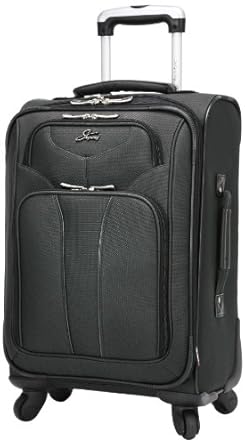
- Wheels are awesome. The invention of the 2-wheeled roll-aboard was a huge improvement. But when you have 30-50 pounds of crap you're dragging around, having a 4-wheel luggage on casters is a Godsend. If you can, get a carry-on with 4 wheels.

- Hard case luggage will not guarantee protection from damage from aggressive baggage handlers. It's fairly simple physics: the energy caused by force acting on your bag has to "go" somewhere. For cheaper hard case bags this likely means the zipper/clasps will break. For more pricey bags it can mean your belongings are taking the brunt of that force. I don't necessarily have anything against hard case luggage but just know that they're not going to magically prevent damage en-route.
- Pack Light. If you don't need it, don't bring it. If you're taking a longer trip, a small package of powdered soap weighs much less than more clothes.
- If you're trying to bring back anything fragile (souvenirs, alcohol, indigenous fauna, etc), dirty laundry makes a very good protective wrap. I have brought back innumerable bottles of wine wrapped in laundry in my checked bag without ending up with a single wine-coloured t-shirt. But, if it's something particularly valuable and/or precious to you, don't check it. Carry it with you if you can or have it shipped home.
- On that note, DO NOT PACK VALUABLES IN CHECKED LUGGAGE. In 10 seconds of searching I was able to find story after story after story of people having valuables (including everything from laptops to hundreds of thousands of dollars in jewelry) go missing from their checked luggage en-route. Yet again, if it's something particularly valuable (especially electronics) and/or precious to you, don't check it. Carry it, ship it, or just leave it at home.
- Once you're done packing, make sure to weigh your bag. Use the bathroom scale if you have to. It may not be accurate, but it will give you an idea of where you stand. Get a $15 luggage scale if you want more accuracy. You don't want to show up to the airport to find out you're overweight. Never be this person:

- Check on the baggage allowance and maximum weight your airline allows. This is usually around 50 lbs (22 kg), but it can vary. Also note that this will generally vary depending on both how much you paid for your ticket as well as how far you're going. As a general rule, the more you pay and the further you're going, the more free baggage you're allowed. You can find some information on Netflights.com but I would recommend checking with your airline at least a few days before your departure. Also be aware that airlines can and do change their policies. Just because it worked last year does not mean it will work this year.
- If you are not flying direct to your destination, make sure to ask when you check in whether your luggage is checked through to your destination. Depending on whether you have to clear customs and what country you're going to, you may need to collect your bag at some point in your trip. For example, if you are flying from point A in Canada to point B in Canada and then connecting to point C in the US, you may have to collect your bags before clearing American customs at point B. Your airline will usually tell you this at check-in. If they don't just ask.
- Finally, the one thing most people don't consider is the part of your travel that won't be in the airport. When deciding on the type/size/weight of your bag, consider how you will be getting to/from the airport. For example, when Jessica and I moved to France we had 4 VERY large and VERY heavy suitcases. But we were getting dropped off by family members with large vehicles in Edmonton and getting picked up by a taxi van in Paris. If you're catching a bus or subway at your destination, keep in mind that hauling a big heavy suitcase through a crowded subway station after a multi-hour flight will make for a bad day.
I think that covers most of my lessons learned. As a final piece of advice, remember that it's "just stuff". If something goes wrong, you can almost certainly replace what you need and it'll make for a great story you'll be telling for years.
Happy Flying!


No comments:
Post a Comment